
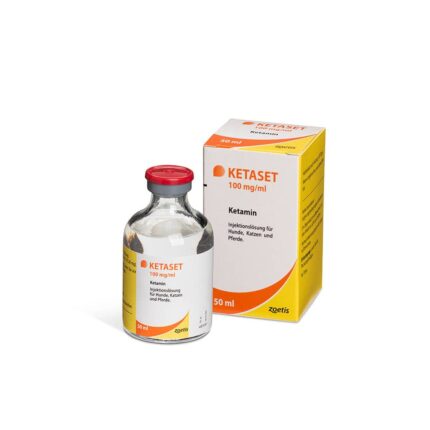
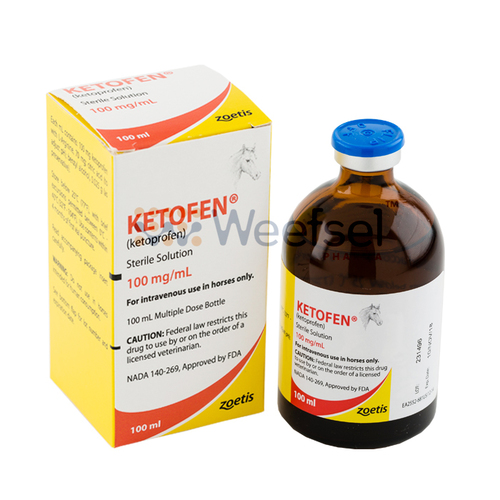
Buy Ketofen Injection (100 mg/mL) / Ketoprofen Solution: The Definitive Guide to Non-Steroidal Anti-Inflammatory Therapeutics, Pharmacology, and Clinical Management
Managing acute pain, severe musculoskeletal inflammation, pyrexia (fever), colic associated with visceral pain, and soft tissue trauma in equine athletes, cattle, and companion animals requires a powerful, fast-acting non-steroidal anti-inflammatory drug ($\text{NSAID}$). When acute inflammatory cascades lead to elevated body temperature, debilitating lameness, soft tissue swelling, and systemic distress, rapid parenteral intervention is essential to restore comfort and physiological stability.
Left unmanaged, severe inflammatory responses and unmitigated pain result in prolonged recovery windows, tissue damage, decreased performance, and severe animal distress.
Relying solely on mild oral analgesics frequently proves inadequate for severe acute equine colic or deep musculoskeletal trauma.
To provide potent analgesic, anti-inflammatory, and antipyretic efficacy backed by extensive veterinary clinical standards, practitioners rely on gold-standard propionic acid derivative formulations. Ketofen Injection (commonly formulated as a sterile aqueous solution containing Ketoprofen $100\ \text{mg/mL}$) is a premier, professional-grade parenteral $\text{NSAID}$. Packaged in multi-dose glass vials, Ketofen Injection delivers targeted cyclooxygenase inhibition engineered specifically for advanced veterinary care.
Ketofen Injection Pharmacology & Kinetic Mechanism
Ketofen Injection delivers a targeted biochemical mechanism engineered to suppress pain pathways and halt systemic inflammation:
                  [Ketofen Injection 100 mg/mL Administered (IV or IM)]
                                              |
                   [Rapid Systemic Absorption and Distribution into Extracellular Fluids]
                                              |
               [Dual Inhibition of Cyclooxygenase (COX-1 & COX-2) and Lipoxygenase Pathways]
                                              |
               -------------------------------------------------
              |                                                 |
     [BLOCKADE OF PROSTAGLANDIN SYNTHESIS]      [INHIBITION OF LEUKOTRIENE PRODUCTION]
   (Prevents Production of Pro-Inflammatory Mediators) (Reduces Visceral & Soft Tissue Inflammation)
              |                                                 |
              v                                                 v
   [Rapid Analgesic & Antipyretic Action]      [Alleviation of Equine Colic & Lameness]
   (Controls Pain Signals & Lowers Fever)       (Relieves Spasms, Swelling, & Joint Pain)
              |                                                 |
              v                                                 v
   [Hepatic Metabolism & Renal Excretion]      [Sustained Systemic Comfort]
   (Cleared Safely from System Over Time)       (Restores Normal Mobility & Appetite)
              |                                                 |
               =========================> <=====================
                                              |
                                              v
                   [Complete Suppression of Acute Inflammatory & Visceral Pain Cascades]
                                              |
                   [Normalized Temperature, Eliminated Colic Pain, & Restored Athletic Vigor]
1. Dual Inhibitory Mechanism of Action
Ketoprofen is a non-steroidal anti-inflammatory drug belonging to the propionic acid class. Unlike selective $\text{COX-2}$ inhibitors, ketoprofen exhibits dual inhibition by blocking both the cyclooxygenase ($\text{COX-1}$ and $\text{COX-2}$) pathways (halting prostaglandin and thromboxane synthesis) and the lipoxygenase ($\text{LOX}$) pathway (inhibiting leukotriene production). This comprehensive blockade makes it exceptionally effective at controlling visceral pain (such as equine colic) and acute musculoskeletal inflammation.
2. Pharmacokinetic and Elimination Profile
Rapid Bioavailability: Absorbed swiftly following parenteral administration, achieving peak plasma and synovial concentrations within minutes to hours.
Short Elimination Half-Life: Clears predictably from the systemic circulation primarily via renal excretion, allowing precise short-term control during acute flare-ups.
Primary Clinical Indications
Ketofen Injection 100 mg/mL is utilized across key veterinary sectors for acute inflammatory management:
Equine Musculoskeletal Disorders: Treatment of inflammation and pain associated with equine osteoarthritis, lameness, soft tissue injuries, tendinitis, and post-surgical trauma.
Equine Colic Management: Alleviation of visceral pain and smooth muscle spasms associated with equine colic, providing rapid analgesic relief.
Bovine and Companion Animal Care: Management of pyrexia, respiratory disease complexes, and acute soft tissue inflammation under professional veterinary direction.
Recommended Administration and Dosing Protocols
To guarantee absolute safety, proper bioavailability, and tissue compatibility, Ketofen Injection must be administered strictly according to approved route and weight-based guidelines.
Dosing Reference Table
The table below outlines standard operational parameters for Ketofen Injection ($100\ \text{mg/mL}$):
| Target Species | Clinical Indication Focus | Standard Dosage Rate | Administration Route & Frequency |
| Equine (Horses) | Musculoskeletal Pain & Inflammation | $2.2\ \text{mg/kg}$ ($1\ \text{mL}$ per $100\ \text{lbs}$) | Intravenous ($\text{IV}$) or Intramuscular ($\text{IM}$), once daily |
| Equine (Horses) | Acute Visceral Pain (Colic) | $2.2\ \text{mg/kg}$ ($1\ \text{mL}$ per $100\ \text{lbs}$) | Intravenous ($\text{IV}$) single or repeated dose per vet |
| Bovine (Cattle) | Pyrexia & Inflammatory Conditions | $3\ \text{mg/kg}$ ($1.4\ \text{mL}$ per $100\ \text{lbs}$) | Intravenous ($\text{IV}$) or Intramuscular ($\text{IM}$) |
Clinical Safety, Precautions, and Storage
Contraindications: Do not use in animals with pre-existing renal, hepatic, or gastrointestinal ulcer disease, or those experiencing active hemorrhages or blood dyscrasias. Avoid concurrent administration with corticosteroids or other $\text{NSAIDs}$.
Injection Site Precautions: When administering intramuscularly, inject deep into large muscle masses and rotate sites to minimize local tissue irritation. Intravenous administration must be performed carefully to avoid perivascular leakage.
Storage Parameters: Store unopened glass vials at controlled room temperatures between 15°C and 30°C (59°F and 86°F). Protect from direct sunlight and freezing.
Frequently Asked Questions (FAQ)
What is the active ingredient in Ketofen Injection?
Ketofen Injection contains Ketoprofen at a concentration of $100\ \text{mg/mL}$, functioning as a potent non-steroidal anti-inflammatory drug ($\text{NSAID}$).
How is Ketofen Injection typically administered in horses?
In horses, it is most commonly administered via intravenous ($\text{IV}$) injection for rapid onset of action in managing musculoskeletal pain or acute colic.
How long can Ketofen Injection therapy be continued?
Standard protocols limit continuous administration to 3 to 5 consecutive days to prevent adverse gastrointestinal or renal complications associated with long-term $\text{NSAID}$ use.
Where can I buy genuine Ketofen 100mg/ml Injection online?
You can safely source authentic, pharmaceutical-grade Ketofen Injection online through Pet Well Global. We store all veterinary pharmaceutical and emergency inventory under rigorous climate-controlled conditions to guarantee absolute product freshness, safety, and full potency.
Secure Professional Sourcing from Pet Well Global
At Pet Well Global, we understand that managing acute equine colic, fever, and severe musculoskeletal pain requires absolute product reliability and rapid fulfillment. Every vial of Ketofen Injection is sourced through authorized veterinary distribution networks, stored in our climate-controlled facility, and handled with precision.
Ketoprofen Injection is a sterile injection containing 100mg/mL Ketoprofen for intramuscular or slow intravenous injection in horses and cattle.
Ketoprofen Injection is a sterile injection containing 100mg/mL Ketoprofen for intramuscular or slow intravenous injection in horses and cattle.
Ketofen Injection 10% solution for injection.
Presentation of Ketoprofen Injection
A clear, sterile, aqueous solution for injection containing 100 mg/ml ketoprofen. Benzyl alcohol is added at 10 mg/ml as a preservative.
Uses for Ketoprofen Injection
Ketoprofen is a potent, non-narcotic, non-steroidal anti-inflammatory agent with analgesic and anti-pyretic properties.
In the horse
10% is indicated for the alleviation of inflammation and pain associated with musculo-skeletal disorders. It is also indicated for the alleviation of visceral pain associated with colic.
In cattle
KETOFEN 10% is indicated for:
The supportive treatment of parturient paresis associated with calving;
Reducing the pyrexia and distress associated with bacterial respiratory disease when used in conjunction with antimicrobial therapy as appropriate;
Improving the recovery rate in acute clinical mastitis, including acute endotoxin mastitis, caused by gram negative micro-organisms, in conjunction with antimicrobial therapy;
Reducing oedema of the udder associated with calving.
In pigs
KETOFEN 10% is indicated for:
Reducing the pyrexia and respiratory distress associated with bacterial or viral respiratory disease when used in conjunction with antimicrobial therapy as appropriate.
The supportive treatment of Mastitis Metritis Agalactia Syndrome in sows, in conjunction with antimicrobial therapy as appropriate.
Dosage and administration
Horse
For use in musculo-skeletal conditions, the recommended dosage is 2.2 mg/kg ketoprofen, i.e. 1 ml of KETOFEN 10% per 45 kg bodyweight, administered by intravenous injection once daily for up to 3 to 5 days.
For use in equine colic, the recommended dosage is 2.2 mg/kg (1 ml per 45kg) bodyweight, given by intravenous injection for immediate effect. A second injection may be given if colic recurs.
Ketoprofen Injection for Cattle
The recommended dose is 3 mg ketoprofen per kg bodyweight, i.e. 1 ml of KETOFEN 10% per 33 kg bodyweight, administered by intravenous or deep intramuscular injection once daily for up to 3 days.
Ketoprofen Injection for Pigs
The recommended dose is 3mg ketoprofen per kg bodyweight, i.e. 1ml of KETOFEN 10% per 33kg bodyweight administered once by deep intramuscular injection.
Contra-indications, warnings, etc
For animal treatment only.
Avoid intra-arterial injection.
As the effects of ketoprofen on fertility, pregnancy or foetal health in horses have not been determined, Ketofen Injection 10% should not be administered to pregnant mares. KETOFEN 10% may be given to pregnant and lactating cattle and is indicated for use in lactating sows.
Do not administer to horses, cattle or pigs that have previously shown a hypersensitivity to ketoprofen.
In case of accidental self injection seek medical advice. Wash hands after use.
Avoid splashes on the skin and eyes. Irrigate thoroughly with water should this occur. If irritation persists seek medical advice.
Do not administer other non-steroidal anti-inflammatory drugs (NSAIDs) concurrently or within 24 hours of each other. Some NSAIDs may be highly bound to plasma proteins and compete with other highly bound drugs which can lead to toxic effects.
Do not exceed the stated dose or the duration of treatment. Use is contraindicated in animals suffering from cardiac, hepatic or renal disease, where there is the possibility of gastro-intestinal ulceration or bleeding, where there is evidence of a blood dyscrasia or hypersensitivity to the product. Use in any animal less than 6 weeks of age or in aged animals may involve additional risk. If such use can not be avoided, animals may require a reduced dosage and careful management.
Avoid use in any dehydrated, hypovolaemic or hypotensive animal as there is a potential risk of increased renal toxicity.
Concurrent administration of nephrotoxic drugs should be avoided.
Withdrawal periods
Horses, cattle and pigs must not be slaughtered for human consumption during treatment.
There is no withholding period necessary for the milk of treated cattle.

Reviews
There are no reviews yet.