
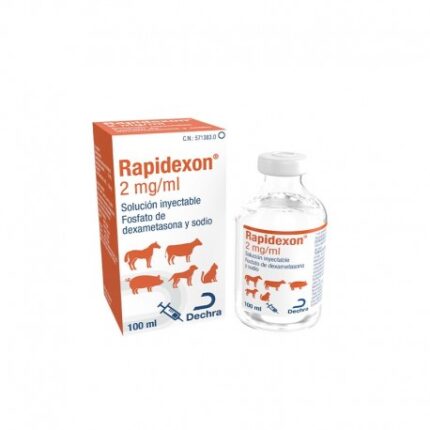
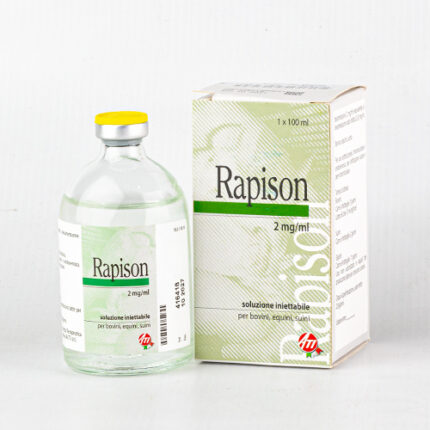
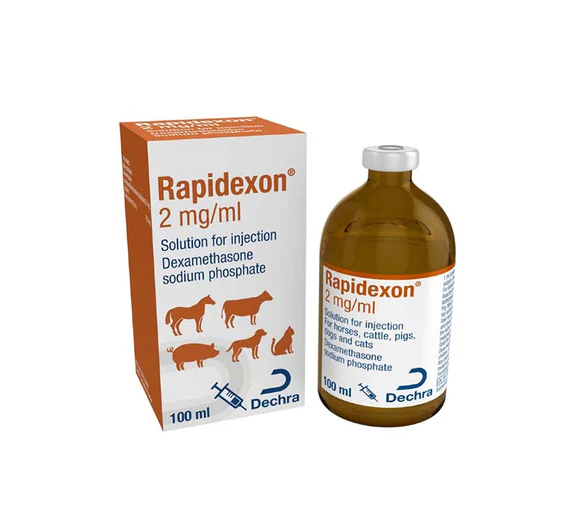
Buy Rapidexon 2ML Online for Sale
Fast-Acting Dexamethasone Injection for Veterinary Use
Rapidexon 2 mg/mL is a veterinary injectable containing dexamethasone sodium phosphate, a potent corticosteroid used to manage inflammatory, allergic, and corticosteroid-responsive conditions in multiple animal species. It is approved for use in horses, cattle, pigs, dogs, and cats under veterinary supervision.
At Pet Well Global, we supply genuine veterinary medicines sourced from trusted manufacturers, ensuring quality, authenticity, and dependable care for veterinarians, breeders, livestock producers, and pet owners.
What is Rapidexon 2ML?
Rapidexon is a sterile injectable solution containing 2 mg/mL dexamethasone sodium phosphate. As a synthetic glucocorticoid, it provides rapid anti-inflammatory, anti-allergic, and immunosuppressive effects, making it useful in treating a wide range of veterinary conditions where corticosteroid therapy is indicated.
Because Rapidexon is a prescription medicine, it should only be administered by or under the supervision of a licensed veterinarian.
Key Features
Potent Corticosteroid
Contains Dexamethasone Sodium Phosphate 2 mg/mL for rapid anti-inflammatory and anti-allergic activity.
Broad Veterinary Applications
Approved for use in horses, cattle, pigs, dogs, and cats for inflammatory and allergic conditions.
Multiple Administration Routes
Depending on the condition being treated, Rapidexon may be administered by:
- Intramuscular (IM)
- Intravenous (IV)
- Intra-articular (IA)
- Intrabursal injection
Administration should always follow veterinary guidance.
Prescription Veterinary Medicine
Intended for professional veterinary use under veterinary prescription.
Active Ingredient
Each mL contains:
- Dexamethasone Sodium Phosphate – 2 mg
Benefits
- Helps reduce inflammation and swelling
- Supports treatment of allergic reactions
- Assists in managing arthritis, bursitis, and synovitis in horses
- Supports treatment of primary ketosis (acetonemia) in cattle where indicated
- Rapid onset of corticosteroid activity
- Suitable for multiple veterinary species under professional supervision
Common Veterinary Applications
Veterinarians may prescribe Rapidexon for:
- Inflammatory disorders
- Allergic reactions
- Arthritis
- Bursitis
- Tenosynovitis
- Primary ketosis (cattle)
- Other corticosteroid-responsive conditions based on veterinary assessment
Why Buy Rapidexon from Pet Well Global?
When you order from Pet Well Global, you receive:
- Genuine veterinary medicines
- Trusted veterinary pharmaceutical brands
- Secure online shopping
- Competitive pricing
- Worldwide shipping where legally permitted
- Professional customer support
- Carefully packaged products
Frequently Asked Questions
What is Rapidexon used for?
Rapidexon is used to treat inflammatory and allergic conditions in horses, cattle, pigs, dogs, and cats. In horses it is also indicated for arthritis, bursitis, and tenosynovitis, while in cattle it may be used for primary ketosis when prescribed by a veterinarian.
What is the active ingredient?
Rapidexon contains Dexamethasone Sodium Phosphate 2 mg/mL.
Which animals can receive Rapidexon?
Rapidexon is approved for:
- Horses
- Cattle
- Pigs
- Dogs
- Cats
How is Rapidexon administered?
Depending on the condition being treated, Rapidexon may be administered by intramuscular, intravenous, intra-articular, or intrabursal injection. Administration should always be performed by or under the supervision of a licensed veterinarian.
Is Rapidexon a prescription medicine?
Yes. Rapidexon is a prescription-only veterinary medicine in many countries and should only be used under veterinary supervision.
Can competition horses receive Rapidexon?
Dexamethasone is a controlled medication in most equestrian and racing competitions. Owners and trainers should consult their veterinarian and the relevant governing authority regarding withdrawal periods before competition.
Storage Instructions
- Store below 25°C.
- Do not freeze.
- Keep the vial in the original carton to protect it from light.
- Keep out of reach of children and animals.
Why Veterinarians Choose Pet Well Global
Pet Well Global is committed to providing:
- Genuine veterinary medicines
- Premium animal healthcare products
- Secure payment options
- Reliable worldwide shipping
- Competitive pricing
- Dedicated customer support
- Products sourced from trusted veterinary manufacturers
Buy Rapidexon –2ML Online
Rapidexon 2 mg/mL Injection is a trusted veterinary corticosteroid containing dexamethasone sodium phosphate for the treatment of inflammatory, allergic, and corticosteroid-responsive conditions in horses, cattle, pigs, dogs, and cats. When administered under veterinary supervision, it provides rapid anti-inflammatory support as part of a comprehensive treatment plan.
Order Rapidexon 2ML Online today from Pet Well Global for genuine veterinary medicines, secure online shopping, competitive pricing, and reliable worldwide delivery where legally permitted.
Pharmacodynamic properties: This preparation contains the sodium phosphate ester of dexamethasone, a fluoromethyl derivative of prednisolone, which is a potent glucocorticoid with minimal mineralocorticoid activity. Corticosteroids reduce the immune response by inhibiting the dilation of the capillaries, migration and function of leukocytes and phagocytosis. Glucocorticoids act on metabolism by increasing gluconeogenesis..
Indications and target species
Equine, Camel, Dogs and Cats: Dexamethasone can be used for the treatment of inflammatory and allergic processes.
Equine/ Camel: Treatment of arthritis, bursitis or tenosynovitis.
Contraindications
• Except in emergency situations, do not use in animals suffering from diabetes mellitus, renal failure, heart failure, hyperadrenocorticism or osteoporosis.
• Do not use in virosis during the viraemic phase or in cases of systemic mycosis.
• Do not use in animals suffering from gastrointestinal or corneal ulcers, or demodicosis.
• Do not administer intraarticularly when there are signs of fractures, bacterial joint infections or aseptic bone necrosis.
• Do not use in case of hypersensitivity to the active substance, to corticosteroids or to any excipients.• Corticosteroids may cause iatrogenic hyperadrenocorticism (Cushing’s syndrome) during treatment, which causes a significant alteration in the metabolism of fats, carbohydrates, proteins and minerals; For example, redistribution of body fat, weight gain, weakness and loss of muscle mass and osteoporosis can occur. During treatment, effective doses suppress the hypothalamic-pituitary-adrenal axis. After treatment discontinuation, signs of adrenal insufficiency can occur which can lead to adrenal cortical atrophy and this may render the animal unable to cope properly with stressful situations. Therefore, care should be taken to minimize the problems of adrenal insufficiency after treatment withdrawal (for more information, see standard texts).
• Systemically administered corticosteroids can produce polyuria, polydipsia, and polyphagia, especially during the initial stages of treatment. Some corticosteroids may produce water and sodium retention and hypokalemia in case of prolonged use. Systemic corticosteroids have caused sedimentation of calcium in the skin (cutaneous calcinosis).
• The use of corticosteroids may delay wound healing and immunosuppressive actions may weaken resistance to infections or aggravate existing infections. In the presence of bacterial infection, concurrent antibacterial treatment is usually necessary. In the presence of viral infections, corticosteroids may aggravate the disease or accelerate its progression.
• Gastrointestinal ulcers have been reported in animals treated with corticosteroids and these ulcers may become worse with corticosteroids in patients receiving non-steroidal anti-inflammatory drugs and in animals with medullary trauma.
• Administration of corticosteroids may lead to increased liver size (hepatomegaly) with increased serum liver enzymes and may increase the risk of acute pancreatitis. Other possible adverse reactions associated with the use of corticosteroids include retention of placenta, metritis, subfertility, laminitis, reduction in milk production and changes in the biochemical and hematological parameters of the blood. There may be transient hyperglycemia.
Route of administration
• Intravenous, intramuscular, intraarticular, intrasynovial or local administration: Horses and camel
• Intramuscular injection: Dogs and Cats.
low fertility as a consequence.


Reviews
There are no reviews yet.